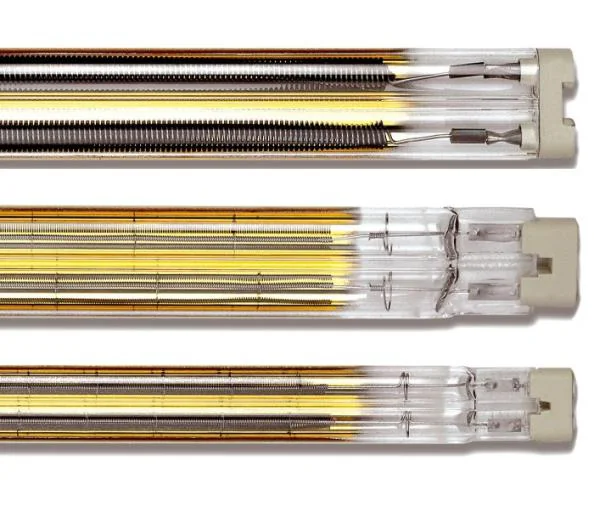
Through technical collaboration with leading international light-source manufacturers, TingHao supplies short-wave, fast medium-wave, medium-wave, and carbon medium-wave twin-tube emitters. By matching wavelength and power density to the absorption characteristics of the heated material, energy is delivered quickly and precisely in a non-contact manner, saving up to approximately 50% energy compared with conventional convection heating.
Heating principle
Non-contact radiant heating delivers energy directly into the object being heated.
Any object above absolute zero emits infrared radiation; industrial heating elements typically range from 500–2200°C. Infrared is electromagnetic radiation, requiring no heating of the air or an intermediate medium — it can be switched on instantly when needed and heats only where needed, so it reacts quickly, uses less energy, takes up little space, and keeps the work environment cleaner.
Non-contact, medium-free
Energy reaches the workpiece surface directly as electromagnetic waves, without first heating the surrounding air — heating starts the instant it is switched on and stops the instant it is off.
Fast response with precise temperature control
Short-wave and carbon medium-wave can reach working power in as little as 1–2 seconds, enabling precise control of the heating curve to avoid overheating and improve yield and throughput.
Three optical effects
When infrared strikes an object, reflection, transmission, and absorption occur; only the “absorbed” energy converts into heat — choose the right wavelength for the best absorption efficiency.
More energy-efficient and eco-friendly
Energy is concentrated on the heated object with low loss; compared with convection systems that continuously heat the air, it greatly reduces energy use and carbon emissions.
Comparison of the three heat transfer modes: radiation, convection, and conduction
Comparison item
Radiation (IR quartz tube)
Convection
Conduction
Heating speed
Fast (approx. 3–5 sec)
Medium
Slow
Cooling speed
Fast
Medium
Slow
Heating efficiency
Good
Medium
Low
Energy loss
Low
High
High
Working environment
Clean
Standard
Poor
Choose the right wavelength
When wavelength matches the material's absorption characteristics, heating becomes both fast and energy-efficient.
The emitted infrared wavelength is mainly determined by the temperature of the heating element (filament) and can be estimated with the peak-wavelength formula; selecting the corresponding emitter based on the absorption band of the heated material is the most critical step in planning infrared heating.
Peak wavelength formula
Peak wavelength (µm) = 2898 ÷ absolute temperature (K)
Absolute temperature (K) = Celsius temperature (°C) + 273. For example, a filament at 900°C: 2898 ÷ (900 + 273) ≈ 2.47µm, which falls in the medium-wave band. The higher the filament temperature, the shorter the peak wavelength and the stronger the penetration.
Short-wave (near-infrared, < 2µm)
Strong penetration reaches deep beneath solid surfaces, delivering uniform heating of thick parts.
Medium-wave (2–4µm)
Mainly absorbed by material surfaces, ideal for surface and thin-layer heating; plastics, glass and especially “water” absorb medium-wave extremely well.
The ideal match for water and plastics
Water molecules have high absorption in the medium-wave band, so medium-wave lamps evaporate water faster; plastics such as PE and PVC also have excellent absorption in the medium-wave band.
Long-wave (far-infrared, > 4µm)
Longest wavelength with low filament temperature, suitable for low-temperature drying and similar applications, but with lower energy density and slower response.
Heater categories
Short-wave, fast medium-wave, medium-wave and carbon medium-wave — choose from the full range of wavebands.
Leading international manufacturers offer full-spectrum infrared heaters for industrial applications, letting customers choose the most suitable waveband for their process and heated material. Below are representative technical parameters for the gold-reflector twin-tube series and the carbon medium-wave emitter.
gold-reflector twin-tubeQuartz twin-tube × gold reflective coatingHigh power densityTransfers large amounts of energy in a short timeTwin-tube design
A gold-coated reflective film nearly doubles effective radiation.
The unique twin-tube structure is made of high-quality quartz, with a gold reflector coating on the back that focuses the radiation toward the workpiece, nearly doubling the effective radiation for maximum efficiency. It offers high mechanical stability and high power density, supports single-ended or double-ended connection, and can be paired with electrical control and power control systems.
Spec comparison of gold-reflector twin-tube and carbon medium-wave emitters
Technical parameters
Medium-wave MW
Fast-response medium-wave FMW
Short-wave SW
carbon medium-wave twin-tube
Peak wavelength
2.4–2.7 µm
> 1.4 µm
1.0–1.4 µm
Approx. 2 µm
Filament temperature
800–950°C
1400–1800°C
1800–2400°C
Approx. 1200°C
Linear power density
18 / 20 / 25 W/cm
80 W/cm
< 200 W/cm
60 W/cm
Maximum area power density
60 kW/m²
150 kW/m²
200 kW/m²
110 kW/m²
Response time
1–4 minutes
1–2 seconds
Approx. 1 second
1–2 seconds
Maximum heating length
1500 / 2000 / 6500 mm
6400 / 2400 mm
6400 / 2400 mm
5000 mm
Cross-section
18×8 / 22×10 / 33×15 mm
34×14 / 23×11 mm
34×14 / 23×11 mm
34×14 mm
The carbon medium-wave emitter is also available in a carbon round-tube form (30 W/cm, maximum length 1500 mm, cross-section ⌀19 mm, surface power approx. 85 kW/m²). The actual model, length, voltage, and power density can be customized to the application.
Heating Module
Perfectly tuned, standardized modules ready to install on site.
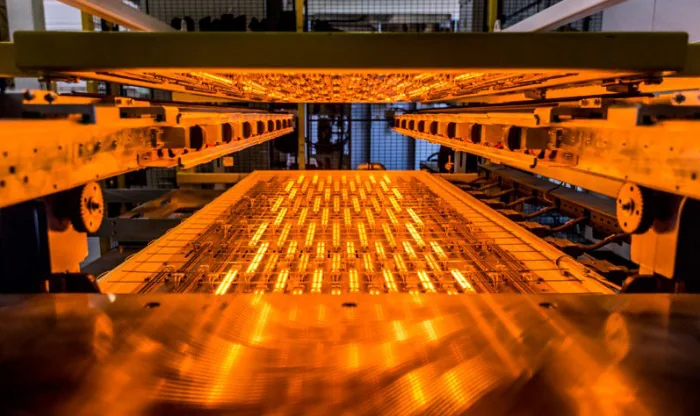
The infrared heating module is an application-optimized, ready-to-install standardized heating unit equipped with short-wave or carbon medium-wave heaters, a stainless-steel housing with exhaust function, and 230V and 400V control units. The heater and module are pre-calibrated, making it a fast-integration solution for industrial infrared applications.
Multiple sizes and power ratings, selected to match heating length and layout.
Module dimensions
Heater type
Heated length
Power range
500 × 510 mm
SW / CIR
300–340 mm
2.4–7.2 KW
500 × 680 mm
SW / CIR
500–600 mm
4–18 KW
500 × 810 mm
SW / CIR
500–600 mm
6–18 KW
500 × 1225 mm
CIR
1000 mm
8–24 KW
Industry applications
Real-world processes spanning glass, automotive, textiles, metals, and medical devices.
Below are typical applications and results of infrared heating across various industries (illustrative of product use), which can serve as a reference for process improvement; actual implementation will be re-evaluated and selected according to your production line.
Glass industry
Glass tempering and heat treatment
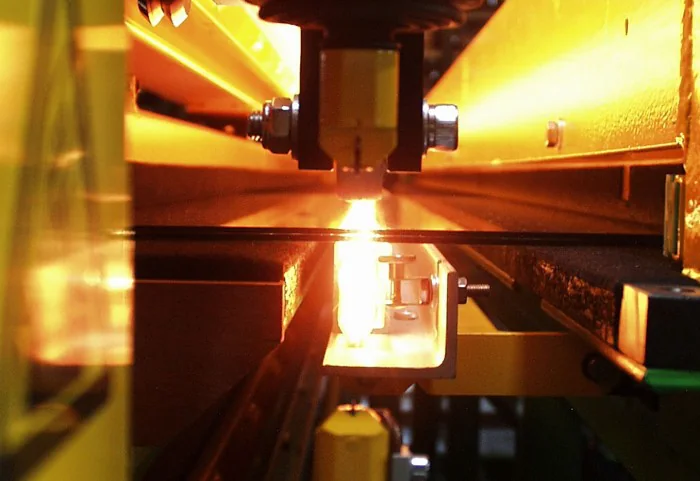
Short-wave infrared achieves rapid, uniform heating, with a heating rate of up to approximately 50°C per second, a process temperature of about 600°C, and a heating/cooling cycle of about 5 minutes. Compared with conventional electric furnaces, the processing speed is increased roughly fivefold and energy consumption is greatly reduced; it can also assist in separating the interlayer film when cutting laminated glass (PVB).
Automotive industry
Interior lamination and coating curing
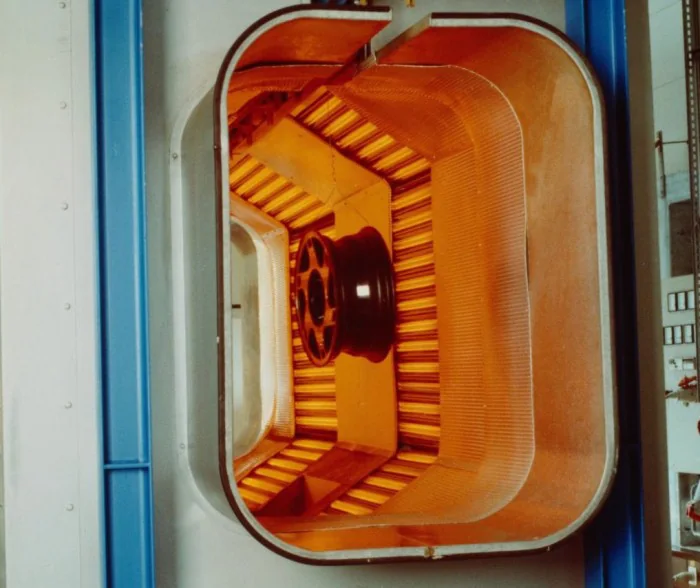
Vacuum lamination of PVC and TPO roll materials uses fast medium-wave, shortening the cycle without preheating; powder-coating curing of metal parts such as aluminum rims switches to carbon medium-wave, with a 1–2 second fast response and precise temperature control — boosting throughput while improving surface quality and reducing energy consumption and carbon emissions.
Textile industry
Coating drying (water-repellent / fire-resistant)
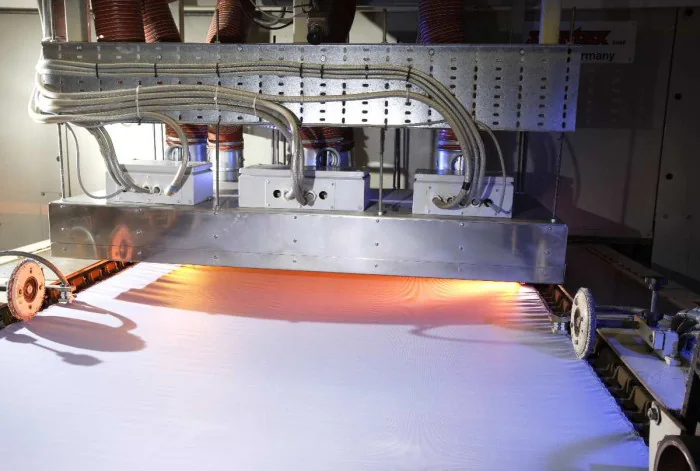
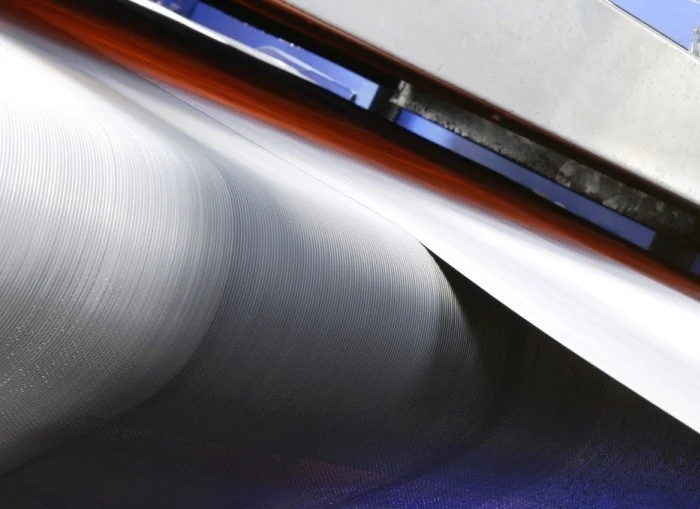
Adding a carbon medium-wave or medium-wave module at the entrance of an existing stenter enables precise temperature control to avoid damaging the fabric. Drying of water-repellent coatings can increase line speed by about 6%; drying of fire-retardant coatings can roughly triple the drying speed compared with conventional long-wave heating.
Metal industry
Metalworking and aerospace forming
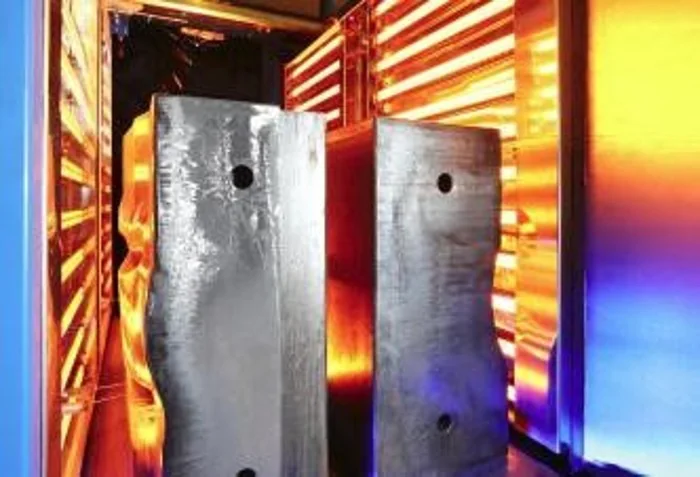
Protective coatings on the weld seams of metal containers are dried using segmented carbon medium-wave modules, with each segment independently set for heating/cooling curves to improve yield. After replacing 24-hour gas heating with short-wave for the 200°C pre-heating of aerospace titanium-alloy parts before forming, the processing time per part was reduced from about 10 hours to 90 minutes.
Healthcare & hygiene
Medical and hygiene material drying
100% PP nonwoven fabric is a low-melting-point, easily softened material, which fast medium-wave can dry efficiently without damaging it; activated-carbon filter media are dried with a medium-wave infrared module, balancing speed and quality.
General-purpose process
Drying · Curing · Shrink Packaging
It is also widely used for drying coatings and paints, curing inks, plastic films and sheets, food drying, shrink packaging, and localized heating of workpieces; whole-line planning and integration with conveying equipment are available.
The technologies described on this page derive from technical collaboration with leading international light-source manufacturers; application photos are illustrative of product use, and actual models, specifications, benefits, and supply are subject to case-by-case evaluation and quotation.
Need model selection or a quotation?
Tell us your process and what you're heating, and we'll help you choose the wavelength and power.